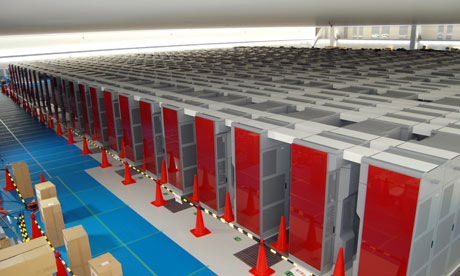
1. Supercomputer - a very large and fast computer
in e.g The Japan's SUPERCOMPUTER, K is the world's fastest.
Photo: http://static.guim.co.uk/sys-images/Media/Pix/gallery/2011/6/21/1308642833304/Japanese-supercomputer-K-007.jpg
2. Reconstructing - to find out and describe or show the way an event or series of events happened
in e.g They are attempting to RECONSTRUCT the events that led to the accident.
or to build (something damaged or destroyed) again
After the hurricane, a lot of houses needs to be RECONSTRUCTED.
3. Usability - capable of being used (synonym: utilize)
in e.g We are determining the USABILITY of the new technique in teaching special children.
4. Restricted - having definite rules about what or who is allowed and not allowed
in e.g Some toxic chemicals are RESTRICTED in China.
5. Collaborate - to work with another person or group in order to achieve or do something
in e.g Bill Gates confirmed that he has COLLABORATED with China in making the next-generation nuclear reactor.
New Quake System Created:
Researchers to be able to accurately predict earthquake aftermaths
The team, led by Takuto Maeda, an associate professor at the University of Tokyo's Center of Integrated Disaster Information Research (CIDIR), has used the new system on a current-generation supercomputer, which almost succeeded in reconstructing the aftermath of the Great East Japan Earthquake on March 11.
Predictions about tremors, tsunami and crust movements have been made separately in the past. But the system's simultaneous calculations are more likely to predict damage that would have been missed by separate findings, such as how a tsunami might impact an area where the ground level has sunk due to an earthquake.
The system's usability was confirmed by its ability to make predictions that were very close to what occurred in the aftermath of the Great East Japan Earthquake.
But the system was restricted by the processing power of the current-generation supercomputer. A large amount of data must be processed to simultaneously calculate crustal movements and tsunami. Current--generation supercomputers lack sufficient storage capacity to process these calculations, and therefore some data was skipped.
Despite this, the team has further developed the system to predict more accurate damage in anticipation for its use on the nation's next-generation supercomputer, known as K, which has a data storage capacity 100 times greater than the current generation, and will be available in autumn.
Meanwhile, the University of Tokyo's Earthquake Research Institute is planning to develop another system for the K supercomputer from April that will analyze urban damage caused by earthquakes and tsunami, such as the collapse of buildings, and predict how certain regions should be evacuated.
The research team also plans to collaborate with the institute.